How to light a fire under Democratic presidential candidates
After years of attacks from the Trump administration, Illinois Democrats could push their next nominee to be more combative on the road to the White House

Welcome to the D.C. Vock newsletter, a mix of news and analysis from a very versatile Washington-based reporter. Please share this with friends and social media if you find it compelling, and subscribe if you haven’t already. My goal is to get 200 subscribers for this newsletter. And if you’re an editor in need of a freelance or full-time politics and policy reporter, well, let’s talk. My LinkedIn profile is here, and you can find me at dcvock at gmail.
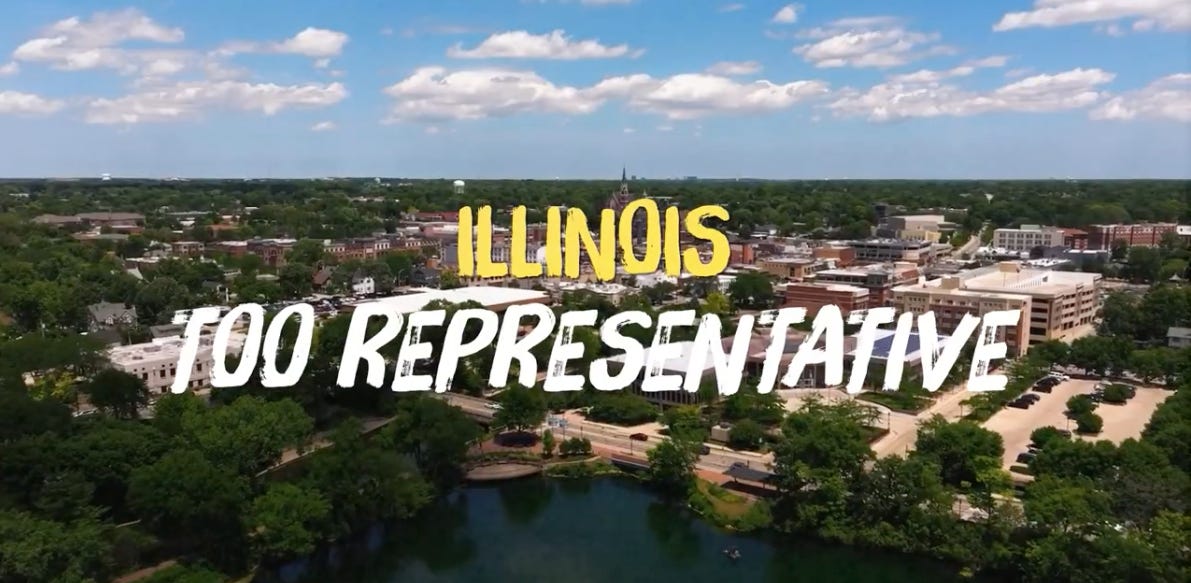
A screenshot from a video promoting Illinois’ bid to become an early primary state in the next Democratic presidential contest.
One way Democrats could push their next presidential nominee to be more assertive — and maybe, by extension, more authentic — is to put Illinois in the line-up of early primary states.
I am, of course, a fifth-generation Illinoisan who, while living in D.C., still makes a decent part of my living following and reporting on Illinois politics. But you don’t have to be deeply invested in Illinois at all to appreciate why giving the Prairie State a prominent spot in the primaries would shake things up.
The Democratic National Committee is considering Illinois as one of three states that could potentially hold an early Midwestern nominating contest, with Iowa and Michigan also vying for the slot.
I covered a meeting of the DNC’s Rules and Bylaws Committee this week for the Chicago Tribune (here’s a gift link to my story), so of course I was especially interested in Illinois’ chances. One committee member from North Dakota asked what made Illinois different enough from other states vying for an early slot.
“I’m struggling to see what is especially unique about Illinois that will help our candidates win,” he said.
As an outside observer, I think one thing that sets Illinois apart from other contenders is its firsthand experience bearing the brunt of Trump administration actions.
Although Trump won’t be on the ballot in 2028, his legacy will certainly color voters’ expectations for their next president.
Democratic political operative David Axelrod famously said, when choosing presidents, “people don’t choose a replica of what they had; they choose the remedy.” But is the remedy someone who is conciliatory and appeals to rural residents and the white working class who once backed Trump? Or is it someone who wins people over with a vision that appeals to the party’s core voters?
The answer could depend on which states get to decide.
Iowa is an increasingly Republican state — although that may change this year — with a disproportionately white and rural population that botched its last major Democratic caucuses in 2020. In Michigan, Democratic Gov. Gretchen Whitmer has taken a decidedly less aggressive approach to Trump since his return to the White House. Michigan’s experience as an early voting state for Democrats in 2024 saw a robust “uncommitted” movement to highlight opposition to Democratic President Joe Biden’s accommodation of Israel as it killed thousands of Palestinian residents in Gaza.
Even among the remaining early primary contenders — Delaware, Georgia, Nevada, New Hampshire, New Mexico, North Carolina, South Carolina, Tennessee and Virginia — none have been targeted by the Trump administration the way Illinois has.
Half of the 12 contenders are led by Republican governors. Democrats in those jurisdictions have a different list of worries, as they confront Republican power plays closer to home.
Tennessee Republicans, for example, just effectively eliminated the last U.S. House seat held by a Democrat in their state, by splitting predominantly Black Memphis into three congressional districts. Iowa Republicans, like GOP lawmakers around the country, severely limited access to abortion. Georgia, South Carolina and Tennessee have all tried to lure auto factories by severely weakening labor unions.
In states with Democratic governors, Whitmer and North Carolina’s Josh Stein have to contend with legislative Republicans who can block their agenda. Virginia’s Abigail Spanberger just took over for a Republican earlier this year. Although Delaware launched Biden’s political career, neither it nor New Mexico have had a prominent role in national politics since Trump returned to office.
That leaves Illinois as a solid blue state where residents not only expect Democrats to enact liberal policies but expect their leaders to stand up for them.
Trump has put Illinois and Chicago in his crosshairs, but Illinois’ top politicians haven’t backed down.
Gov. JB Pritzker hasn’t tried to find common ground with right-wing podcasters on restricting the rights of transgender girls like Gavin Newsom has in California. He isn’t talking up his crossover appeal to MAGA voters like Josh Shapiro has in Pennsylvania. He hasn’t had to hide his face behind a folder in an Oval Office meeting like Whitmer did last year. And, though he never really had a chance, it’s hard to imagine that Pritzker would free an election-denying public official convicted of tampering with election equipment to mollify Trump like Jared Polis of Colorado did earlier this month.
That might just be Pritzker’s disposition, but it’s also good politics in Illinois. In March 2016, Trump cancelled a campaign rally in Chicago because of concerns about safety. The president has rarely set foot in Illinois since. And many Illinois Democrats grew frustrated lately with U.S. Sen. Dick Durbin, a fixture in the state’s politics for half a century, because Durbin voted to confirm some Trump nominees and to approve a Republican budget deal while Trump dismantled large parts of the federal government. Durbin, now 81, opted not to run for reelection this year.
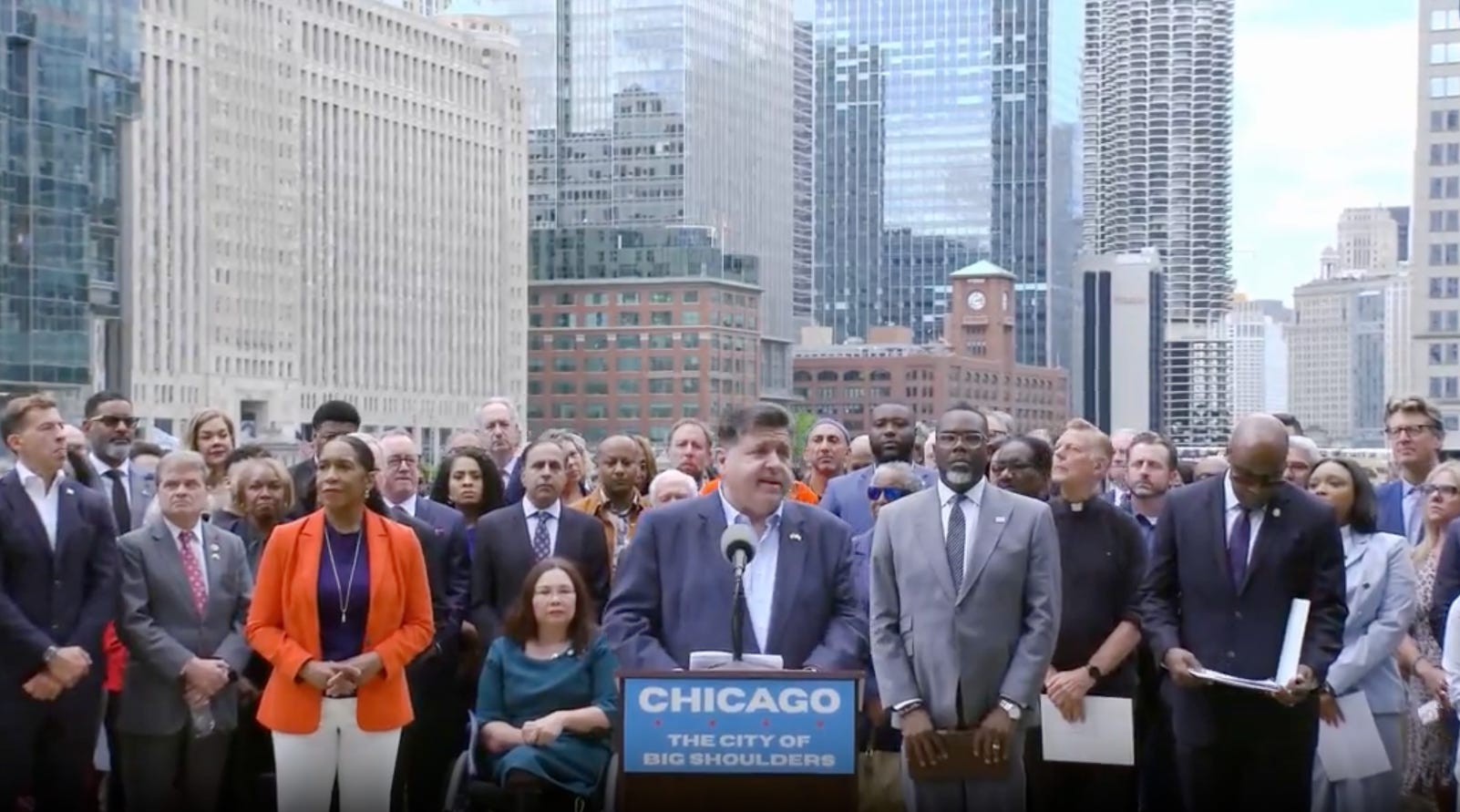
A who’s who of Illinois politicians joined Illinois Gov. JB Pritzker in Chicago last August as he said he was “ringing an alarm” about the possibility of military troops being deployed to the Chicago area.
In March, Lt. Gov. Juliana Stratton won a three-way primary to succeed Durbin with a simple message: “Fuck Trump.” “I’m not scared of a wannabe dictator,” she said in an ad that touted the explicit message, “I’m running for Senate to stand up to Donald Trump.” One of the debates in that race was how far the candidates would go — not whether to — to abolish Immigration and Customs Enforcement. One of Stratton’s opponents led the effort by House Democrats to impeach Kristi Noem, who was then Trump’s secretary of homeland security.
As I mentioned before, that same primary featured a House race on Chicago’s North Side and northern suburbs featuring several candidates trying to demonstrate their strident opposition to ICE arrests and other Trump administration initiatives. Although she came in second, political newcomer Kat Abughazaleh distinguished herself in that race by taking a prominent role in protesting outside an ICE processing center during the administration’s Operation Midway Blitz — and getting thrown to the ground in the process. Federal prosecutors charged Abughazaleh and five others — several of them involved in Democratic politics — for interfering with ICE operations. But the case against the “Broadview Six” fell apart in fantastic fashion over the last two weeks, with a federal judge now considering sanctions for lawyers in the U.S. attorney’s office for how they handled grand jury proceedings.
Pritzker, now seeking a third term, announced last year that he was not interested in appeasing Trump any longer.
There are people — some in my own party — who think that if you just give Donald Trump everything he wants, he’ll make an exception and spare you some of the harm. I’ll ignore the moral abdication of that position for just a second to say — almost none of those people have the experience with this president that I do.
I once swallowed my pride to offer him what he values most — public praise on the Sunday news shows — in return for ventilators and N95 masks during the worst of the pandemic. We made a deal. And it turns out his promises were as broken as the BIPAP machines he sent us instead of ventilators.
Going along to get along does not work — just ask the Trump-fearing red state governors who are dealing with the same cuts that we are.
I won’t be fooled twice.
That was before Pritzker, who is Jewish, invoked the experience of Germany falling under Nazi control as he warned against Trump’s ambitions.
The authoritarian playbook is laid bare here: They point to a group of people who don’t look like you and tell you to blame them for your problems.
I just have one question: What comes next? After we’ve discriminated against, deported or disparaged all the immigrants and the gay and lesbian and transgender people, the developmentally disabled, the women and the minorities — once we’ve ostracized our neighbors and betrayed our friends — after that, when the problems we started with are still there staring us in the face — what comes next?
All the atrocities of human history lurk in the answer to that question. And if we don’t want to repeat history, then for God’s sake in this moment we better be strong enough to learn from it.
And there’s no way Illinoisans will soon forget Operation Midway Blitz. Trump sent federal agents to the Chicago area last fall in a show of force to back up his anti-immigrant policies. The agents used tear gas, their fists, helicopters and even bullets to carry out their mission. Illinois residents came out of their homes to confront and record the agents, blow whistles and warn others on social media. They mounted a flurry of legal challenges until the made-for-TV operation wound down.
Now imagine a Democratic presidential candidate trying to win over these voters.
In a swingier state, it might be tempting for the next round of candidates to skip past questions of how to unravel Trump’s legacy. Politicians rightly want to turn their eyes to the future, with a vision designed to attract supporters — even former Trump supporters — and not repel them.
But the damage done when democratic institutions fail or falter is visceral in Illinois. It can be felt in immigrant communities where people are afraid to gather. It shows up when major infrastructure projects, like an extension of the Chicago L or a barrier to protect the Great Lakes from Asian carp, get delayed arbitrarily. And, of course, it lingers over farms and factories where erratic tariffs could close off export markets that local jobs depend on.
Meanwhile, Democrats in Illinois seem impatient with half measures on key party priorities. Illinois has become an island in the Midwest offering abortion access to women, medical care for transgender children, libraries that aren’t getting censored, and legislative maps that maximize representation for Black and Hispanic communities.
Middle-ground approaches that might seem like progress to Democratic voters in Republican-heavy states like Iowa or Tennessee wouldn’t have the same appeal to an Illinois voter who already expects more.
That’s not to say that Illinois voters are far to the left of the country. The state consistently has a 55-45 Democratic-to-Republican split that Democrats have maximized to the hilt. Illinois has been less aggressive than other Democratic states on issues like limiting greenhouse gas pollution, and its voters seem to have little appetite for the kind of progressive income taxes seen in places like California. If U.S. Rep. Alexandria Ocasio-Cortez of New York or Newsom come through Illinois, they’re likely to get pushback on some of their progressive priorities. Not every Democratic talking point plays well in Peoria.
The biggest question of how effective Illinois could be as a proving ground for presidential candidates, though, has to do with Pritzker. The billionaire governor is a Democratic megadonor for causes across the country, the state’s undisputed political kingmaker (Stratton was his favored candidate in the Senate race) and a potential presidential candidate himself. If he decides to make a White House run, will any of his rivals try to beat him in his home state?
It might not matter. The DNC will likely decide its slate of early voting states before Pritzker announces his intentions for 2028. And, as Iowa and New Hampshire have shown, the person who wins the first primary doesn’t automatically become the party’s nominee.
But if the DNC wants a nominee who sounds like they’re proud to be a Democrat, and not like they’re apologizing for being one, maybe Illinois is a good place to start.